Why Painting Together Is the Screen-Free Family Activity Your Kids Actually Want to Do
Most parents already know their kids are on screens too much. According to a 2025 report from Lurie Children’s Hospital and Common Sense Media, 87% of US children exceed recommended daily screen time guidelines, and children ages 8-18 average 7.5 hours in front of a screen every day. That number hits different when you’re actually watching it happen in your living room.
The problem isn’t really the screen itself. It’s that screens are easy – easy to hand over, easy for kids to fall into, and hard to compete with. What parents actually need isn’t another reminder that screen time is too high. They need something that fills the gap. Something a child will actually choose, at least some of the time, over a tablet.
Painting is that thing. It sounds too simple, almost quaint. But done right – and it doesn’t need to be done perfectly – painting together is one of those activities that holds a child’s attention, builds real skills, and gives you a shared hour you’ll both remember. This article shows you exactly how to make it work at home, even if neither of you has picked up a brush in years.
Why Painting Beats the Screen on a Rainy Afternoon?
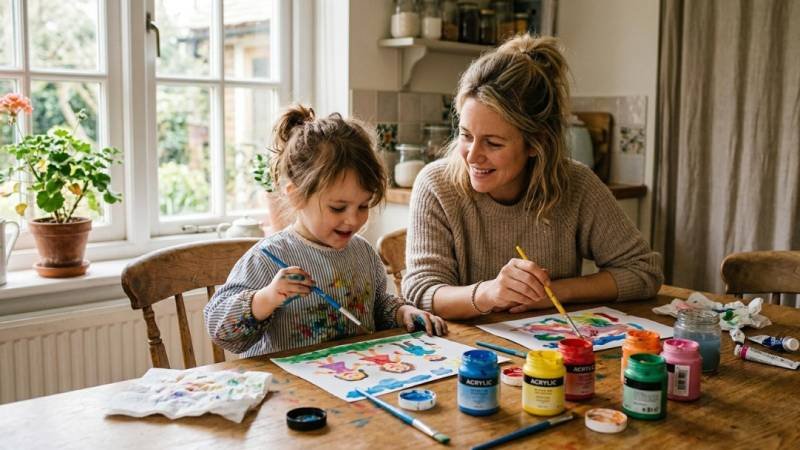
A parent and child painting side by side – simple materials, no screen required.
The usual argument for getting kids off screens is about what you’re taking away from them. Less blue light. Less passive consumption. Less X, Y, Z. That framing misses the point entirely. The better question is what you’re giving them instead.
Painting gives kids something to do with their hands. It gives them a problem to solve – how do I make this look like that flower? – and the freedom to solve it any way they want. There’s no score, no losing, no game-over screen. That low-pressure quality is actually what makes it work for family time. No one’s competing. You’re just sitting there together, making something.
The research backs this up more than you might expect. A 2024 review published in The Arts in Early Childhood journal, covering nine studies and 3,671 children, found that every single included study reported positive outcomes for children’s wellbeing after arts program participation – improved mental health, stronger resilience, better social outcomes. And a 2025 report from the National Endowment for the Arts found that toddlers who did arts activities with a parent showed stronger parent-child relationships, while preschoolers who engaged regularly in arts activities scored higher on reading, math, and language assessments.
Those aren’t small findings. They’re consistent across thousands of kids.
If you’re wondering where to begin as a first-time family painter, you can visit Number Artist for custom paint-by-numbers kits that turn a photo of your choice – a family portrait, a pet, a favourite landscape – into a numbered canvas anyone can follow. It removes the “but I can’t draw” problem completely, which is the main reason most parents never try.
For more ideas on keeping kids engaged without a screen, there’s a full guide worth bookmarking when you’re building out your family activity rotation.
How to Get Started Without Being an Artist Yourself
A paint-by-numbers kit takes the guesswork out of getting started, making it a great first choice for families new to painting.
The single biggest reason parents avoid painting with their kids is some version of “I’m not good at this.” It feels silly to admit, but it’s real. No one wants to sit down and feel incompetent in front of their child.
Structured painting activities remove that barrier. When you’re following a numbered canvas, there’s no blank page intimidation. You’re just filling in section 4 with the blue paint. Your seven-year-old can do the same thing right next to you. Neither of you needs skill – just patience and the right starting point.
For free-form painting sessions, keep the shopping list short. Non-toxic washable paints (a standard set runs under $10), a pad of canvas or heavy watercolour paper, and a few brushes in different sizes. Total spend: under $20. The temptation is to over-buy and over-plan. Don’t. A simple setup is faster to pull out and easier to clean up, which means you’ll actually do it more than once.
One practical tip: set up the table before you invite the kids in. Have the paints open, the water cups ready, the paper already out. When the setup is done, kids walk in and start immediately. The momentum is already there.
When it comes to choosing materials and activities that set younger children up for a good experience, this guide on toys that build creativity and focus has smart, practical recommendations for different ages. Worth a read before your first session.
Using Real Art to Spark Your Child’s Imagination
Exposing kids to real paintings – especially bold, colorful subjects like flowers – gives them visual ideas to bring to their own canvas.
Here’s something most parents skip that makes a real difference: look at paintings before you paint.
Kids paint better when they’ve seen something that interests them. Looking at real artwork – even casually, even just scrolling through images together for five minutes – gives them a visual vocabulary. They start to notice how someone else handled color, how thick or thin the paint looks, how a petal can be suggested with a single stroke rather than outlined perfectly.
Flowers are a particularly good starting subject for kids. The colors are bold and appealing, the shapes are familiar, and there’s no “wrong” version of a flower. A child can make it bright purple with orange spots and it looks intentional. That confidence matters, especially early on.
Try browsing flower paintings for sale together as a family before a session. You may even end up buying one or two pieces you genuinely want for your home. A colorful floral painting in the kitchen, hallway, or child’s bedroom can also make the house feel more creative and personal, reinforcing the idea that art is something meant to be enjoyed every day. Point at paintings you like, talk about the colors, ask your child which one they’d want to hang in their room. It sounds small, but that conversation directly shapes what they want to try on their own canvas and helps turn painting into something the whole family gets excited about.
The 2025 National Endowment for the Arts report notes that early arts exposure builds the kind of “pre-literacy” visual skills that carry into school performance. Looking at paintings isn’t passive – it’s actually doing something for a child’s brain. You can read more about that research at the NEA’s blog on childhood arts experiences.
Making Painting a Habit, Not a One-Off
Displaying kids’ paintings at home turns the activity into something they’re proud of and want to repeat.
One painting session is fun. A weekly painting session is a family tradition. The difference is mostly logistics.
The biggest barrier to repeating any activity with kids is the friction of getting started. If the paints are packed away in a closet behind the board games, they won’t come out very often. Leave them accessible – a small basket on a shelf, a tray on the kitchen counter, somewhere the kids can reach them without asking. The research on habit formation is clear on this: lower the barrier and the behaviour increases. That applies to adults and kids equally.
Display the finished work. This sounds obvious, but a lot of families tuck paintings into a drawer or toss them after a week. Don’t. Put them on the wall. Let your child pick which ones go up. Give them a section of the house that’s genuinely theirs. A 2025 Lurie Children’s Hospital report found that 54% of parents feel their child is “addicted” to screens – part of breaking that pull is giving kids something visible and physical that they made themselves and feel proud of.
A consistent “family art hour” – even 20 or 30 minutes, once a week – adds up fast. By the end of a school term, you’ll have 10 to 15 paintings. Enough to fill a wall. Enough for the kids to start recognising their own style.
Ladybug Child Care Centers note in their overview of art in early childhood development that regular access to art materials – not just occasional exposure – is what builds the fine motor skills and creative confidence that children carry into school. Consistent access is the key word there.
For more on building a broader set of creative activities that make screen-free time easier to maintain long-term, that resource covers a range of approaches worth trying alongside painting.
You Don’t Need Talent – You Just Need to Start
There’s a temptation to treat painting as something you need to “get into” – buy the right gear, take a class first, wait until the kids are old enough to appreciate it. None of that is true. The barrier is entirely in your head.
A parent who sits down with a child and paints badly for 30 minutes has done something real. They’ve been present. They’ve shown their kid that making things matters more than making perfect things. That’s not a small lesson.
The research is consistent: arts activities with a parent improve child wellbeing, strengthen the parent-child bond, and build skills that show up in school performance. Screens can’t do any of that. They’re not bad in moderation – but they don’t give you that.
Pick a weekend afternoon. Set up the table. See what happens. You might be surprised how long everyone stays at it. Click here to see more information.