
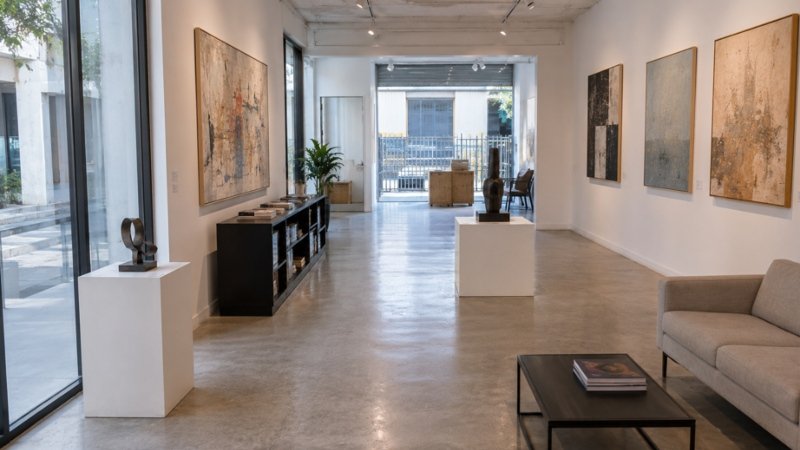
How Galleries and Studios Stay Dust-Free Beside the Workshops
An art space in Al Quoz sits a few metres from panel beaters, joinery workshops and a steady flow of heavy vehicles, and the dust from all of it does not respect gallery walls. Anyone who has hung work in the district around Alserkal Avenue knows how quickly a crisp white wall picks up a grey cast, how a shaft of light through a roller shutter shows particles hanging in the air, and how a framed piece collects a visible layer within a week or two of being installed.
Keeping a studio or gallery genuinely clean in this setting is less about the occasional deep clean and more about controlling dust before it lands on anything that matters. The methods that suit a downtown office can be too rough for artwork, delicate surfaces and freshly painted walls, so the approach has to be gentler, more frequent and planned carefully around whatever is on display.
Where the dust actually comes from
The dust load around a creative unit is a mix of fine construction and workshop particles, road grit carried in on the wind, and the ordinary debris of a space where people make things. Sanding, cutting, spraying and casting all throw particulates into the shared air of a building, and open roller doors let the outside in every time a delivery arrives. This is not the soft household dust of an apartment; it is often abrasive, which matters a great deal once it settles on a canvas or a lacquered surface.
Because the source is constant, the goal is containment rather than a single heroic clean. Sealing gaps around doors, using entrance matting that traps grit, and keeping a sensible barrier between any working, dusty area and the display space all reduce how much ever reaches the walls. Managing air movement so that dust is drawn away from the art rather than across it is part of the same thinking, and it does more good than any amount of wiping after the fact.
Cleaning around artwork without causing harm
Delicate pieces call for methods that never touch the work itself. Soft, dry microfibre and gentle dusting tools lift particles from frames and plinths without dragging grit across a surface, while feather dusters and aggressive sprays are best kept well away from anything valuable. Cleaning products with strong solvents or heavy fragrance can react with varnishes, pigments and mounts, so neutral, low-residue options are the safer default anywhere near original work.
White walls are their own discipline. They show every mark, so they need regular, light attention rather than a heavy scrub that leaves shadows and uneven patches. Teams that regularly provide cleaning services al quoz galleries depend on tend to work in careful passes, touching in scuffs, dusting rails and skirting, and keeping to a schedule that fits around installations and viewings rather than cutting straight across them.
Floors, glass and the air itself
Floors in these spaces are usually polished concrete or resin, chosen to look clean and to hold up under footfall. They still trap fine dust in every pore, so a combination of dust-capturing dry mops and damp cleaning at the right pH keeps them presentable without leaving a residue that pulls more dust back down. Large glazed frontages and display vitrines need frequent, streak-free cleaning too, since smudges and haze are painfully obvious under gallery lighting.
Air quality ties the whole thing together. Good filtration on the air conditioning, filters that are genuinely changed on time, and the occasional use of standalone air purifiers all cut the particle count before it can settle. In a district this dusty, keeping the air clean protects both the look of the walls and the condition of the work far more effectively than repeated surface cleaning ever could.
Getting the frequency right
Frequency is where studios and galleries often slip up. Cleaning only before an opening lets dust build unchecked for weeks, then disturbs it at the worst possible moment. A lighter, more regular rhythm, with quick daily or every-other-day dusting of display areas and deeper work on a set cycle, keeps everything stable and avoids the familiar scramble in the hours before a show.
It also helps to match the schedule to the district itself. Workshop activity, delivery traffic and even the weather all change how much dust hangs in the air, and a plan that flexes with them protects the work better than a fixed monthly visit. For spaces that show or store valuable pieces, this steady, considered approach is what keeps a gallery looking as sharp as the work on its walls deserves.